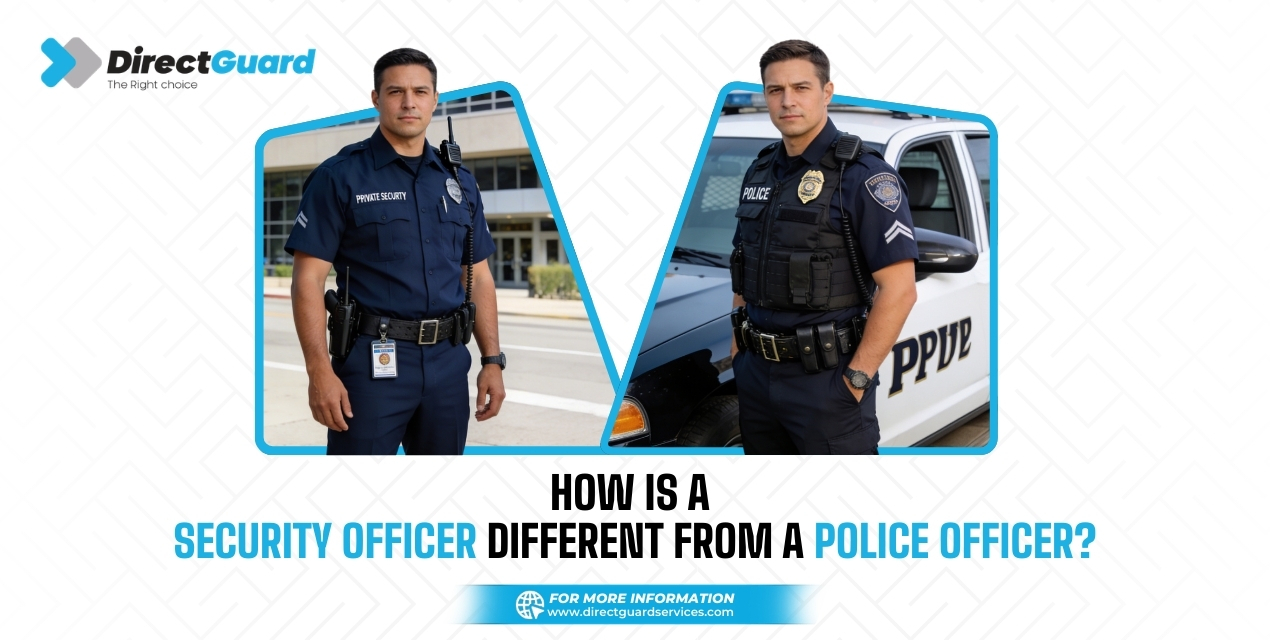
Many people assume that a security officer and a police officer perform the same job. After all, both wear uniforms, respond to incidents, and protect people.
However, the difference between a security officer vs police officer is significant — especially when it comes to authority, responsibilities, training, and legal powers.
Understanding these differences helps businesses, property managers, and individuals choose the right type of protection.
What Is a Security Officer?
A security officer is a trained professional hired by a private company or organisation to protect property, assets, employees, and customers.
Security officers typically work for private security firms and are assigned to locations such as:
- Commercial buildings
- Construction sites
- Residential communities
- Retail stores
- Corporate offices
- Industrial facilities
Their primary role is prevention and deterrence.
What Is a Police Officer?
A police officer is a sworn law enforcement official employed by a government agency such as a city, county, state, or federal department.
Police officers are responsible for:
- Enforcing laws
- Conducting criminal investigations
- Making arrests
- Responding to public emergencies
- Maintaining public order
They serve the broader community rather than a single private client.
Security Officer vs Police Officer: Key Differences
Below is a clear breakdown of the differences between a security officer vs police officer.
1. Authority and Legal Powers
Security Officer:
- Limited authority
- Can detain individuals (citizens’ arrest laws vary by state)
- Cannot conduct full criminal investigations
- Operates under private property rules
Police Officer:
- Full law enforcement authority
- Can make arrests
- Can carry out investigations
- Enforces criminal and traffic laws
- Has legal jurisdiction
The biggest distinction in the security officer vs police officer comparison is legal authority.
2. Employer and Oversight
Security Officer:
- Employed by private security companies
- Assigned to specific properties or clients
- Overseen by company management
Police Officer:
- Employed by government agencies
- Accountable to public institutions
- Funded by taxpayers
Security officers protect specific clients, while police officers protect the public.
3. Primary Responsibilities
Security Officer Duties:
- Monitor surveillance systems
- Patrol property
- Control access points
- Respond to alarms
- Write incident reports
- Deter criminal activity
Police Officer Duties:
- Respond to emergency calls
- Investigate crimes
- Conduct traffic stops
- Issue citations
- Make arrests
- Testify in court
Security focuses on prevention. Police focus on enforcement.
4. Training Requirements
Training differs significantly in the security officer vs police officer comparison.
Security Officer Training:
- State-mandated licensing (varies by location)
- Basic security procedures
- Emergency response protocols
- Report writing
- De-escalation training
Police Officer Training:
- Police academy training (several months)
- Criminal law education
- Firearms training
- Defensive tactics
- Investigative techniques
- Ongoing certification requirements
Police training is more extensive due to broader authority.
5. Jurisdiction
Security Officer:
- Limited to the assigned property or client site
- Authority applies only within that location
Police Officer:
- Has authority within city, county, or state jurisdiction
- Can act anywhere within legal boundaries
This jurisdictional difference is critical when determining who should respond to specific incidents.
6. Cost and Availability
Security Officer:
- Hired directly by businesses
- Available for ongoing on-site presence
- Cost-effective for prevention
- Provides immediate property-specific response
Police Officer:
- Responds when dispatched
- May handle multiple emergencies at once
- Response time varies
- No direct hiring for private full-time protection
Businesses that require a consistent security presence rely on professional security officers.
When Should You Hire a Security Officer?
You should consider private security services if:
- You need constant on-site protection
- You want crime deterrence
- You manage high-traffic properties
- You require access control
- You need alarm response coverage
- You want preventative security rather than reactive enforcement
Security officers reduce risk before crimes occur.
When Are Police Officers Needed?
Police officers are necessary when:
- A serious crime occurs
- An arrest must be made
- An investigation is required
- Public safety is threatened
- Legal enforcement is necessary
Security officers often coordinate with police when situations escalate beyond private authority.
How Security Officers and Police Work Together
It’s important to understand that this is not a competition between security officer vs police officers.
Instead, they complement each other.
Security officers:
- Detect issues early
- Document incidents
- Contact law enforcement when required
- Preserve scene integrity
Police officers:
- Take legal action
- Conduct investigations
- Enforce criminal laws
Together, they create layered protection.
Why Businesses Choose Professional Security Services
While police departments serve the community, they cannot provide continuous private property monitoring.
Professional security officers offer:
- Dedicated on-site presence
- Faster response for property-specific incidents
- Visible deterrence
- Customised security strategies
- Preventative protection
For businesses, prevention is more cost-effective than reacting after a crime occurs.
Protect Your Property with Professional Security Services
Understanding the difference between a security officer vs police officer helps you make informed decisions about your protection needs.
If your property requires ongoing monitoring, deterrence, and rapid response, professional security services are the right solution.
Prevention starts with the right protection strategy.
Frequently Asked Questions
- Can a security officer arrest someone?
Security officers may perform a citizen’s arrest depending on local laws, but their authority is limited compared to that of police officers. - Do security officers carry weapons?
Some security officers are armed, depending on licensing, training, and client needs. Others are unarmed. - Are security officers considered law enforcement?
No. Security officers are private professionals and are not sworn law enforcement officers. - Who responds faster to property issues?
Security officers typically respond faster on private property because they are already assigned to that location.