Key Takeaways
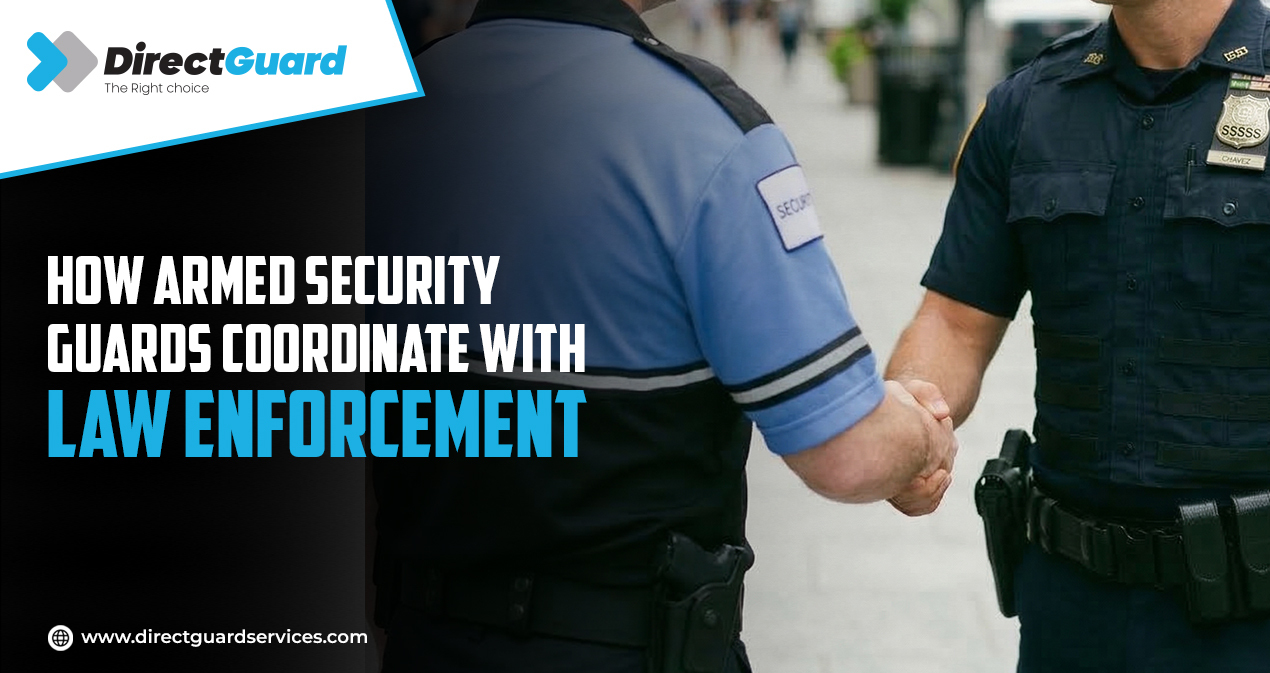
- Armed security guards and law enforcement operate as a coordinated team — not as competing or overlapping forces.
- Professional armed security guards are trained in specific communication protocols that allow seamless handoff to law enforcement during emergencies.
- The coordination between armed guards and police begins long before an incident occurs — through pre-planning, site briefings, and established communication channels.
- Armed security guards serve as the first line of response while law enforcement is en route — buying critical time that saves lives and limits damage.
- DG Security Services deploys armed security guards who are trained in law enforcement coordination protocols for businesses, facilities, and events of all types.
Introduction
Most people think of security guards and police officers as two entirely separate things — one private, one public, one showing up first, the other showing up after. That picture is incomplete, and in high-stakes situations, that misunderstanding can cost lives.
The relationship between armed security guards and law enforcement is not a handoff at the moment of crisis. It is an ongoing, structured partnership built on shared communication, pre-established protocols, mutual training, and clearly defined roles that begin long before any incident occurs and continue long after it is resolved.
When a threat materialises at a facility, an event, or a business, the armed security guard on the ground is not simply waiting for police to arrive. They are managing the situation in real time, relaying critical information to responding officers, controlling access and movement, protecting potential victims, and creating the conditions that allow law enforcement to respond as effectively as possible the moment they arrive on scene.
Understanding how armed security guards coordinate with law enforcement is essential for any business, facility manager, or organisation that relies on professional security services. It explains the true value of a trained armed security guard — not just as a deterrent, but as a fully integrated component of the public safety ecosystem.
This guide covers exactly how that coordination works, what protocols are involved, what training makes it possible, and why it matters for the safety of your people and your property.
The Relationship Between Armed Security Guards and Law Enforcement
To understand how armed security guards coordinate with law enforcement, it helps first to understand what each party brings to a security situation and where their roles naturally intersect.
- Law enforcement officers — police, sheriff deputies, federal agents — are government employees with the legal authority to make arrests, conduct investigations, detain suspects, and enforce criminal law. They operate across an entire jurisdiction, responding to hundreds of different calls simultaneously with limited resources. Their average response time to a priority call in most urban areas ranges from four to eleven minutes. In suburban and rural areas, that response time can be significantly longer.
- Armed security guards are private professionals licensed to protect specific people, property, or facilities. They are present on-site before, during, and after their shift — providing continuous, localised protection that law enforcement cannot realistically provide. They know the layout of the building, the daily routines of the facility, the identities of regular visitors, and the specific risks and vulnerabilities of their assigned location.
- These two roles are not redundant. They are complementary. Law enforcement provides legal authority, investigative capability, and the full weight of the criminal justice system. Armed security guards provide continuous on-site presence, immediate threat response, location-specific knowledge, and the critical first minutes of incident management that determine how a situation unfolds before police arrive.
- The Federal Bureau of Investigation recognises private security as a critical component of the public safety infrastructure. The FBI’s Private Sector Program actively promotes coordination between law enforcement agencies and private security providers because the data consistently shows that integrated public-private security partnerships produce significantly better outcomes during critical incidents.
This relationship works best when it is built deliberately — through preparation, communication, shared protocols, and mutual respect between professional security personnel and law enforcement agencies.
How Coordination Begins Before Any Incident Occurs
The most important thing to understand about how armed security guards coordinate with law enforcement is that effective coordination does not begin when an incident starts. It begins weeks or months before any threat materialises — through deliberate pre-planning that establishes the foundation for seamless real-time response.
Site Familiarisation with Local Law Enforcement
Professional armed security providers establish direct contact with the local police precinct or sheriff’s department responsible for the geographic area where their client’s facility is located. This contact serves multiple purposes. It ensures that responding officers are familiar with the facility layout, access points, and known risk areas before they ever receive an emergency call from that location. It establishes personal relationships between security personnel and law enforcement officers that make real-time communication faster and more effective during a crisis.
Emergency Response Plan Development
Before armed security guards are deployed to any facility, a comprehensive emergency response plan is developed in collaboration with facility management and with input from local law enforcement. This plan establishes clear protocols for every type of potential incident — active shooter response, robbery, medical emergency, civil disturbance, trespassing, and fire — including exactly how and when law enforcement will be notified, what information will be communicated, and how the handoff from security to law enforcement will be managed.
Communication Channel Establishment
Pre-incident coordination includes establishing the specific communication channels that armed security guards will use to contact law enforcement during an emergency. This includes direct non-emergency and emergency law enforcement contact numbers, radio frequency coordination where applicable, and, in some cases, direct access to police dispatch through private security partnerships.
Key Contact Identification
Effective coordination requires knowing whom to call and how to reach them quickly. Professional armed security teams maintain updated contact lists for local law enforcement command staff, facility emergency contacts, building management, and emergency services — and those lists are reviewed and updated regularly.
Threat Intelligence Sharing
Law enforcement agencies frequently share non-sensitive threat intelligence with private security partners operating in their jurisdiction — including information about crime patterns, known criminal activity in the area, and specific threat indicators relevant to certain types of facilities. Armed security guards who are plugged into these information-sharing relationships are better positioned to recognise and respond to emerging threats before they escalate.
Communication Protocols During an Active Incident
When an incident occurs, the communication between armed security guards and law enforcement is not improvised. It follows specific, pre-established protocols that are designed to provide responding officers with the most critical information as quickly and clearly as possible.
The Initial Call to Law Enforcement
When an armed security guard identifies a situation that requires law enforcement response, the initial call to emergency services follows a structured format that law enforcement agencies refer to as the five W’s — who, what, where, when, and weapons. A trained armed security guard communicates these elements in the first thirty seconds of the call.
Who is involved — the number of suspects, their descriptions, including clothing, height, build, and any distinguishing features. What is happening — the specific nature of the incident, whether it is in progress, and any injuries or threats to life. Where exactly the incident is occurring — the specific location within the facility, including floor, wing, or area, and the last known direction of movement of any suspects. When the incident began, providing officers with a timeline helps them assess the situation as they respond—weapons — whether any weapons have been observed, their type, and whether shots have been fired.
This structured communication allows dispatch to relay accurate, actionable information to responding officers while the armed security guard continues managing the situation on the ground.
Ongoing Real-Time Updates
After the initial call, armed security guards maintain open communication with law enforcement dispatch throughout the incident — providing real-time updates as the situation develops. This includes changes in suspect location or behaviour, additional victims or witnesses, changes in the threat level, and any actions taken by security personnel.
Radio and Communication Discipline
During an active incident, communication discipline is critical. Armed security guards are trained to communicate clearly, concisely, and without emotional language that can slow the transfer of information. They use standard terminology, avoid ambiguous descriptions, and confirm critical information when requested by dispatch.
Identifying Themselves to Responding Officers
One of the most critical coordination protocols during an active incident is the procedure for armed security guards to identify themselves to arriving law enforcement officers. This is a non-negotiable safety protocol. A responding officer arriving at an active incident cannot immediately distinguish between an armed security guard and a suspect. Professional armed security guards are trained in specific identification procedures — including positioning, verbal identification, weapon handling, and physical compliance with law enforcement directives — that prevent dangerous misidentification.
The Role of Armed Security Guards While Law Enforcement is in Route
The minutes between when an incident begins and when law enforcement arrives are the most critical period of any security event. What happens in those minutes determines whether a situation is contained or escalates, whether victims are protected or further endangered, and whether the scene is managed or descends into chaos.
This is where the value of a trained, professional armed security guard is most clearly demonstrated.
Immediate Threat Containment
An armed security guard’s priority during an active incident is to contain the threat — preventing it from spreading to additional areas of the facility or reaching additional potential victims. This may involve positioning to create a physical barrier between the threat and occupied areas, directing building occupants to safe locations, or, in active threat scenarios, engaging the threat directly if innocent lives are in immediate danger.
Evacuation Management
Simultaneously with threat containment, armed security guards coordinate the evacuation of uninvolved building occupants through pre-established exit routes, away from the area of the incident and toward safe rally points where they can be accounted for. This evacuation management serves two purposes — it protects occupants, and it clears the facility, making it easier for responding law enforcement to identify and engage the actual threat.
Scene Control and Perimeter Establishment
Professional armed security guards establish and maintain a physical perimeter around the incident area — preventing unauthorised access, keeping bystanders away from the threat zone, and preserving the scene as much as possible for law enforcement investigation. This perimeter control also ensures that responding officers can move directly to the threat without navigating through crowds of evacuating occupants.
Evidence and Witness Preservation
While managing the immediate threat, trained armed security guards make careful observations and mental notes about the incident — suspect descriptions, sequence of events, statements made by suspects, and the identities and locations of witnesses. This information is immediately communicated to law enforcement upon arrival and forms a critical part of the subsequent investigation.
Continuous Communication with Dispatch
Throughout the period while law enforcement is en route, armed security guards maintain continuous communication with dispatch — providing real-time updates that allow responding officers to arrive with the most current possible picture of the situation they are entering.
How Armed Security Guards Support Law Enforcement on Arrival
When law enforcement arrives on scene, the armed security guard’s role does not end — it transitions. The guard shifts from primary incident manager to active support resource for the arriving officers.
Immediate Scene Briefing
The first thing an armed security guard does when law enforcement arrives is provide a rapid, structured briefing to the ranking officer. This briefing covers the current status of the threat, the last known location and description of any suspects, the status of evacuations and known locations of remaining occupants, any actions taken by security personnel, and any injuries or medical needs. This briefing takes thirty to sixty seconds and gives responding officers the situational awareness they need to take effective command of the scene immediately.
Armed security guards serve as essential guides for law enforcement in unfamiliar buildings. They provide direct access through locked doors and secured areas, guide officers to the specific location of the threat, and prevent officers from wasting critical time navigating an unfamiliar facility layout.
Ongoing Perimeter Support
While law enforcement officers focus on the primary threat, armed security guards continue managing the outer perimeter — controlling access, directing evacuating occupants, managing bystanders, and maintaining communication with additional responding units. This division of labour allows law enforcement to concentrate entirely on resolving the threat while security personnel handle the surrounding environment.
Witness Management and Information Gathering
Armed security guards assist law enforcement by gathering and organising witness information, directing witnesses to designated interview locations, preventing witnesses from leaving the scene before being documented, and providing their own detailed observations as part of the official incident record.
Compliance with Law Enforcement Direction
Once law enforcement takes command of a scene, armed security guards operate entirely under the direction of the ranking officer. Professional guards are trained to be responsive, cooperative, and immediately compliant with any instruction given by law enforcement — recognising that the arrival of police marks a command transition from private security management to law enforcement authority.
Post-Incident Coordination and Documentation
Effective coordination between armed security guards and law enforcement does not end when the immediate threat is resolved. The post-incident phase involves several important coordination activities that support law enforcement investigation and protect the facility and its occupants going forward.
Formal Incident Reporting
Armed security guards prepare detailed written incident reports documenting every aspect of the event — timeline of events, descriptions of all parties involved, actions taken by security personnel, communications made, witnesses identified, evidence observed, and any departures from standard protocol. These reports are provided to law enforcement as part of the official investigation record and are retained by the security provider for compliance and liability purposes.
Evidence Preservation Coordination
Armed security guards coordinate with law enforcement to identify and preserve physical evidence — including CCTV footage, access control records, visitor logs, and any physical evidence within the security team’s area of responsibility. Ensuring this evidence is secured and available for investigators is a critical post-incident function.
Witness Statement Support
Security personnel assist law enforcement investigators by providing their own statements, facilitating access to witnesses they identified during the incident, and making available any security system records that support the investigation.
After-Action Review
Following any significant incident, professional armed security providers conduct a formal after-action review with facility management and, where appropriate, with law enforcement liaison contacts. This review assesses what worked, what gaps were identified, and what changes to the security plan or coordination protocols are warranted. The goal is continuous improvement of the security and coordination framework so that each subsequent incident is handled more effectively than the last.
Security Plan Updates
Based on the after-action review and any guidance received from law enforcement, the security plan for the facility is updated to address any identified vulnerabilities or coordination gaps. This iterative improvement process is a hallmark of professional armed security management.
Training That Makes Coordination Possible
The seamless coordination between armed security guards and law enforcement that this guide describes does not happen by accident. It is the product of specific, intensive training that professional armed security guards receive before they are ever deployed to a client site.
- Use of Force Law and Civilian Authority Training ensures that armed security guards understand exactly what authority they have, where it ends, and how it interfaces with law enforcement authority. This training prevents dangerous ambiguity about roles and decision-making during a crisis.
- Emergency Communication Training covers the specific protocols for contacting law enforcement, communicating with dispatch during an active incident, providing structured situation reports, and managing ongoing communication throughout an event. Guards practice these communications in realistic simulations before deployment.
- Law Enforcement Arrival Protocols training specifically addresses the critical moment when police arrive on a scene where an armed security guard is present. Guards are trained in identification procedures, weapon handling, verbal communication, and compliance behaviours that prevent misidentification and ensure a smooth command transition.
- Active Threat Response Training — including ALERRT (Advanced Law Enforcement Rapid Response Training) framework awareness — prepares armed security guards to take appropriate immediate action during active shooter and active threat scenarios while maintaining compatibility with law enforcement response protocols.
- De-escalation and Crisis Intervention Training equips armed guards with the skills to manage volatile situations without escalating to use of force — reducing the frequency and severity of incidents that require law enforcement response in the first place.
- Evidence and Scene Preservation Training ensures that armed security guards know how to protect physical evidence, document observations accurately, and manage witnesses in a way that supports law enforcement investigation without compromising the integrity of the scene.
- Report Writing and Documentation Training develops the written communication skills that armed security guards need to produce accurate, detailed, legally defensible incident reports that serve both their client and law enforcement investigators.
Why This Coordination Matters for Your Business
For any business, facility, or organisation that employs armed security guards, the quality of those guards’ coordination with law enforcement has direct, measurable consequences for safety, liability, and operational continuity.
Faster and More Effective Law Enforcement Response
When armed security guards provide structured, accurate information to dispatch during an incident, responding officers arrive better prepared and respond more effectively. That improved response directly translates into better outcomes — faster threat resolution, fewer injuries, and more successful prosecutions.
Reduced Liability Exposure
A business that can demonstrate that its armed security personnel followed established law enforcement coordination protocols during an incident is significantly better positioned legally than one that cannot. Documentation of proper coordination, clear communication records, and accurate incident reports all contribute to a defensible legal position in the event of litigation.
Faster Return to Normal Operations
Incidents that are managed effectively — with good security and law enforcement coordination — are resolved more quickly and with less disruption than those that are not. Faster incident resolution means faster return to normal business operations.
Enhanced Community and Employee Trust
Employees, customers, and community stakeholders have greater confidence in a facility that they know is professionally secured and integrated with local law enforcement. That confidence has tangible value for employee retention, customer loyalty, and community relations.
Deterrence Effect
The knowledge that a facility employs professional armed security guards who are coordinated with local law enforcement is itself a powerful deterrent. Criminals and threat actors assess security capability before choosing targets. A facility with a visible, professional, law enforcement-integrated security presence is a significantly less attractive target than one without.
How DG Security Services Coordinates with Law Enforcement
At DG Security Services, law enforcement coordination is not a secondary consideration in our armed security guard deployments — it is a foundational element of how we build and operate every security program we manage.
Before our armed security guards are deployed to any client site, we conduct a comprehensive site assessment that includes evaluation of the facility’s relationship with local law enforcement, identification of the responding law enforcement agencies for the location, and development of a customised emergency response plan that aligns with local law enforcement protocols.
Our armed security guards complete training that specifically addresses law enforcement coordination — including emergency communication protocols, active threat response procedures, law enforcement arrival identification protocols, and post-incident documentation standards. This training is not a one-time certification. It is an ongoing part of our professional development program.
We maintain active relationships with law enforcement agencies in our service areas — establishing the pre-incident coordination connections that make real-time response faster and more effective when an incident occurs at a client facility. Our team knows the local law enforcement contacts, and local law enforcement knows our team.
Every armed security guard we deploy is equipped with the communication tools, documentation resources, and operational protocols needed to serve as an effective first responder and law enforcement support asset — from the moment a threat materialises through the completion of post-incident documentation.
Our clients receive not just an armed security guard. They receive a professional who is fully integrated into the public safety system that protects their community.
Final Thoughts
Armed security guards and law enforcement are not two separate systems operating in parallel. At their best, they are a single integrated public safety response — each playing a distinct and essential role, coordinated through preparation, training, and clear communication protocols that allow them to work as one when it matters most.
The businesses, facilities, and organisations that understand this relationship — and that invest in professional armed security services that are built on genuine law enforcement coordination — are the ones that are most prepared when a threat materialises. They have shorter response times, better incident outcomes, stronger legal positions, and greater confidence from the employees and customers who depend on them.
Your security program should reflect that understanding.
Do not settle for armed security guards who show up for a shift. Choose a professional armed security provider whose guards are trained, connected, and fully integrated with the law enforcement community that protects your area.