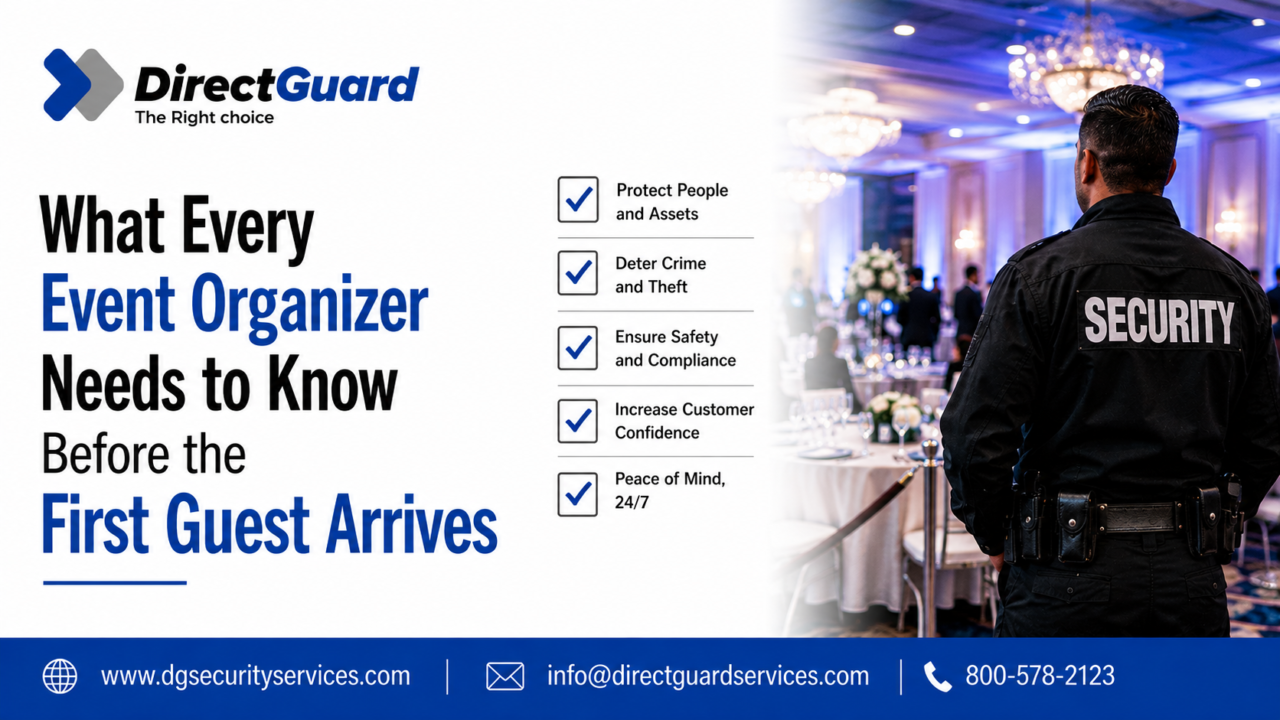
The Question Every Event Organizer Eventually Faces
You’ve booked the venue, confirmed the caterer, sold the tickets, and coordinated the vendors. Then, a week before the event, someone asks: “Did you hire security?”
It’s one of the most common oversights in event planning — and one of the most consequential. In California, event security is not just a best practice. Depending on your event type, venue, alcohol service, crowd size, and permit requirements, it may be a legal obligation. Getting it wrong can result in permit revocations, venue liability, injuries, and incidents that define your event for all the wrong reasons.
This guide covers everything California event organizers need to know: what event security guards actually do, when they are legally required, how to calculate the right number of guards, what to look for when hiring, and how professional event security works in practice.
What Is Event Security?
Event security is a specialized discipline within the broader field of professional security services. Unlike static guard posts at a building or vehicle patrol across a property, event security involves managing the safety of a dynamic, time-limited gathering of people — often in public or semi-public settings where access control, crowd flow, and real-time threat assessment all happen simultaneously.
Event security guards perform functions that are categorically different from standard security guard duties. They must manage large numbers of people calmly and professionally, de-escalate conflicts before they escalate, enforce venue rules without alienating paying guests, coordinate with event staff and local law enforcement, and respond to medical and safety emergencies — all at the same time.
Professional event security is not simply placing a uniformed guard at a door. A well-executed event security plan is a comprehensive operational structure that covers entry, perimeter, interior zones, VIP areas, staff access points, parking, and post-event crowd dispersal.
Types of Events That Require Professional Security Guards in California
Security requirements vary significantly by event type, size, and risk profile. The following categories represent the most common event types that DG Security Services provides security coverage for across California:
Corporate Events and Conferences Trade shows, product launches, shareholder meetings, and corporate galas all present access control challenges and, increasingly, the potential for unwanted disruption. Corporate events also frequently involve the protection of expensive equipment, proprietary information, and high-profile attendees.
Concerts and Live Music Events High-energy environments with large crowds, alcohol service, and emotional audience engagement create elevated security demands. Concert security involves crowd monitoring, barrier management, stage security, artist escort, and post-show crowd dispersal — all within strict timelines.
Festivals and Outdoor Events Multi-day festivals, food and wine events, art fairs, and cultural celebrations in outdoor venues require perimeter security, multiple access points, medical coordination, and large teams working in shifts. California’s outdoor events also carry additional considerations around wildfire risk during dry season.
Sporting Events Amateur and professional sporting events generate crowd dynamics that require experienced security personnel trained in crowd psychology and escalation prevention. From youth sports tournaments to college athletic events, the right security presence makes the difference between a smooth day and a serious incident.
Nightclubs, Bars, and Venues with Alcohol Service California’s Alcoholic Beverage Control (ABC) regulations directly intersect with venue security requirements. Establishments with ABC licenses are expected to maintain order, prevent service to minors, and manage intoxicated patrons. Many ABC license conditions explicitly require licensed security personnel on certain nights or above certain occupancy thresholds.
Private Parties and VIP Events High-profile private events — celebrity gatherings, high-net-worth celebrations, political fundraisers — require discreet, professional security that protects without disrupting the atmosphere. These events often combine armed and unarmed coverage with executive protection elements.
Religious and Community Gatherings Unfortunately, houses of worship and community events have increasingly become targets for hate-motivated incidents. Security at religious gatherings must be sensitive, community-appropriate, and highly trained in threat recognition and de-escalation.
School and University Events Proms, graduation ceremonies, sporting events, and campus concerts all require student-sensitive security professionals who can enforce rules firmly while treating attendees with respect. Many California school districts and universities require licensed security contractors for events above a certain attendance threshold.
Trade Shows and Exhibitions High-value merchandise, restricted exhibitor areas, and thousands of badge-holding attendees create a complex access control environment. Trade show security teams manage badge verification, booth security, after-hours protection, and coordination with convention center staff.
When Is Event Security Legally Required in California?
California does not have a single universal statute mandating security at all events, but multiple overlapping regulatory frameworks can make professional event security a legal requirement depending on your situation:
Venue Permit Conditions
Many California cities and counties require event organizers to submit a security plan as part of the special event permit application process. Local authorities — typically the city’s Special Events Office or the police department’s permit division — review the security plan and may require a minimum number of licensed security guards based on expected attendance, alcohol service, and venue type.
Permit denials or conditions citing inadequate security planning are common. If your event permit conditions include a security requirement and you fail to meet it, the event can be shut down before or during the gathering.
ABC License Conditions
The California Department of Alcoholic Beverage Control (ABC) attaches conditions to many license types. Condition 42, for example — commonly attached to nightclub and bar licenses — requires licensees to maintain order on the premises and may specifically require uniformed security personnel during certain hours. Failure to comply can result in ABC enforcement action, including license suspension or revocation.
For temporary event licenses (such as a special event license for a festival with beer and wine sales), local ABC offices may require a security plan that includes licensed guards.
Venue Requirements
Many California event venues — convention centers, hotel ballrooms, sports facilities, and dedicated event spaces — have their own contractual requirements for security staffing. The venue’s contract or event use agreement will specify minimum security staffing levels, whether the organizer must use the venue’s preferred security vendor or their own licensed contractor, and what insurance documentation is required.
Crowd Size Thresholds
Some California jurisdictions apply crowd-size thresholds. Events exceeding a certain attendance — which varies by city, often between 500 and 1,000 attendees — trigger automatic security staffing requirements as a condition of the special event permit. Los Angeles, San Francisco, San Diego, and other major cities all have event permit frameworks that include these thresholds.
Insurance Requirements
Even where local law doesn’t explicitly mandate security guards, your event insurance policy may. Commercial general liability policies for events frequently include conditions requiring “adequate security measures.” After an incident, an insurer may deny a claim on grounds that security was inadequate — particularly if no licensed, professional security was engaged.
What Do Event Security Guards Actually Do?
A professional event security team operates across multiple functional roles simultaneously. Understanding these roles helps organizers plan properly and communicate clearly with their security provider.
Access Control and Entry Management
The security perimeter begins at the event’s outermost boundary. Entry management guards verify credentials, check tickets or wristbands, conduct bag checks where required, and manage queue flow to prevent dangerous crowding at entry points. Effective entry management is the first and most important line of event security — it determines who gets in and sets the tone for the entire event.
Crowd Monitoring and Management
Inside the event, roving guards continuously monitor crowd density, behavior patterns, and potential flashpoints. Experienced event security professionals can identify a developing conflict, a medical emergency, or an unauthorized access attempt well before it becomes a visible problem. Crowd monitoring is proactive, not reactive.
Perimeter Security
The event’s outer boundary must be secured against unauthorized entry and controlled for exit management. Perimeter guards prevent gatecrashing, secure vendor and staff access points, and monitor for threats approaching from outside the event footprint.
VIP and Artist/Performer Protection
High-profile guests, performers, athletes, and speakers require dedicated personal security coverage that is entirely separate from general crowd security. VIP security involves advance planning of routes, designated holding areas, transport coordination, and close personal protection during public appearances.
Alcohol and Behavior Management
At events with alcohol service, guards work with bartenders and event staff to identify and manage intoxicated patrons before situations escalate. This includes refusing entry to visibly intoxicated individuals, managing disputes calmly, and coordinating removal of disruptive guests without confrontation.
Emergency Response Coordination
Event security guards are the first organized response to any emergency — medical, fire, security incident, or evacuation. Guards coordinate with emergency services, direct crowd movement during evacuation, render basic first aid until paramedics arrive, and maintain communication with the event command post throughout.
Post-Event Crowd Dispersal
The period immediately after a large event ends is statistically one of the highest-risk moments for incidents. Professional event security manages crowd flow at exits, coordinates with parking and transportation, and ensures the venue is safely cleared before standing down.
How Many Security Guards Do You Need for Your Event?
This is the most common question event organizers ask — and the honest answer is: it depends on a set of specific factors. There is no single universal ratio that applies to all events. What follows are the primary variables that determine appropriate guard staffing levels.
Attendance Size
As a general baseline in the security industry, a ratio of one guard per 50 to 100 attendees is commonly referenced for general public events. However, this baseline is just a starting point — the actual ratio is adjusted up or down based on every other factor below.
| Expected Attendance | Baseline Guard Count (General Public Events) |
|---|---|
| Under 100 | 2–3 guards minimum |
| 100–300 | 3–5 guards |
| 300–750 | 6–10 guards |
| 750–2,000 | 10–25 guards |
| 2,000–5,000 | 25–60+ guards |
| 5,000+ | Custom staffing plan required |
Event Type and Risk Profile
A corporate networking reception for 300 professionals requires significantly fewer guards than a 300-person nightclub event with a DJ and an open bar. Risk profile — not headcount — is the primary driver. High-energy entertainment, alcohol service, general admission (as opposed to assigned seating), younger audiences, and controversial speakers all increase the risk profile and therefore the required guard staffing.
Venue Layout and Access Points
The physical layout of the venue directly impacts staffing requirements. Each access point — entry gate, emergency exit, staff entrance, vendor delivery point — needs to be monitored. A venue with 12 access points cannot be secured by 3 guards regardless of attendance size.
Duration and Shifts
Events lasting more than 8 hours require shift rotations to ensure guards remain alert. Multi-day events require overnight security between sessions to protect equipment and the venue. Your total guard count must account for shift coverage, not just the peak period.
Alcohol Service
Any event serving alcohol should increase its guard ratio. California venues with ABC licenses are already aware of this — it is often built into their operating conditions. For temporary event licenses, adding at least one additional guard per major bar station is a commonly recommended practice.
Special Considerations
The presence of political figures, celebrities, or controversial speakers may require close protection details in addition to general event security. Events in high-crime areas or with a documented history of incidents require elevated staffing. Events with competing fan bases — rival sports teams, for instance — require thoughtful crowd separation planning.
The best approach is always to work directly with your security provider to conduct a site assessment and develop a staffing plan tailored to your specific event.
Armed vs. Unarmed Security Guards at Events
This is one of the most important decisions in event security planning and one that many organizers are uncertain about.
Unarmed Security Guards are appropriate for the vast majority of events — corporate gatherings, community festivals, weddings, sporting events, trade shows, and most entertainment venues. Unarmed guards provide a professional, visible security presence, manage access control, handle behavioral issues, and respond to emergencies. They are trained, licensed, and effective.
Armed Security Guards are appropriate when the threat environment warrants a higher level of deterrence and response capability. Scenarios that may call for armed guards include: events hosting high-profile political or government figures, events in locations with elevated crime risk, cash-handling security for box offices or merchandise operations, VIP or executive protection assignments, and certain religious institution events where threat intelligence suggests elevated risk.
Armed guards in California must hold specific licensing through the Bureau of Security and Investigative Services (BSIS), including a Guard Card, an Armed Guard registration, and a Firearm Qualification Card (FQC). Not all security guards are licensed to carry — verify this specifically when engaging an armed security provider.
In many events, the most effective approach is a combination: unarmed guards for general crowd and access management, with armed personnel at specific high-risk positions or covering VIP areas.
What to Look for When Hiring an Event Security Company in California
Not every security company has the experience, staffing capacity, or licensing to handle event security effectively. Here is what to verify before signing a contract:
BSIS Private Patrol Operator (PPO) License Every legitimate security company operating in California must hold a valid PPO license issued by the Bureau of Security and Investigative Services. Ask for the PPO number and verify it at the BSIS public license lookup before engaging any company. Do not hire any security provider that cannot produce a current, valid California PPO license.
Guard Card Verification Every individual security guard working in California must hold a valid BSIS Guard Card. Reputable security companies conduct ongoing license verification for all their personnel. Ask your provider to confirm that all guards assigned to your event hold valid, current Guard Cards.
Event-Specific Experience Security experience at warehouses and construction sites, while valuable, is categorically different from event security. Ask specifically about the company’s experience with events of your type and scale. Request references from comparable events — not just general client references.
Adequate Staffing Capacity A security company that fields 15 guards total cannot staff a 500-person event properly. Verify that your provider has the staffing depth to cover your event fully, including shift rotations, without pulling guards from other commitments.
Liability Insurance Your event security contractor must carry adequate commercial general liability insurance and workers’ compensation coverage. Request certificates of insurance directly — do not accept verbal assurances. Your venue may also require you to add them as an additional insured on the contractor’s policy.
Pre-Event Planning and Communication A professional event security company will want to conduct a site walkthrough, develop a written security plan, establish communication protocols with your event staff, and brief their team before the event begins. If a security provider offers to show up on the day with no advance planning, walk away.
GPS Reporting and Real-Time Accountability Modern professional security companies use GPS tracking and digital reporting platforms so clients can verify guard locations and activity in real time. This level of accountability matters — particularly for multi-guard deployments across a large venue.
Common Event Security Mistakes That Lead to Incidents
Even well-intentioned event organizers make planning errors that create security vulnerabilities. These are the most common mistakes the professional security industry sees:
Underestimating the post-event period. Incidents often occur during crowd dispersal, not during the event itself. Plan explicitly for how guests will exit the venue and how long guards will remain post-event.
Treating security as an afterthought. Security planning should begin at the same time as all other event planning — not in the final week. Late engagement means inadequate advance planning and reduced guard availability.
Choosing based on price alone. The lowest quote often reflects the lowest licensing, training, and accountability standards. Event security is not a commodity — the difference between a well-trained professional team and an inadequately supervised one can be measured in incident outcomes.
Failing to brief security on event-specific rules. Guards cannot enforce rules they don’t know. Every event has specific access policies, prohibited items, photography rules, and behavioral expectations. Brief your security team comprehensively before doors open.
No communication structure between security and event staff. Event staff, venue management, and security guards need a unified communication plan — designated radio channels, a command post contact, and clear escalation protocols. Without this structure, incidents fall through the gaps.
Ignoring parking and approach areas. Many incidents happen in parking lots and approach paths before guests even reach the venue entrance. Perimeter security that ends at the front door is incomplete security.
DG Security Services: California’s Event Security Partner
DG Security Services is a licensed, insured security guard company in California with experience across a wide range of event types — from corporate gatherings and community festivals to private VIP events and large-scale public venues.
Our event security teams are BSIS-licensed, trained in crowd management and emergency response, equipped with GPS-backed reporting technology, and supported by 24/7 dispatch for real-time coordination. We develop written security plans for every event, conduct pre-event site walkthroughs, and brief our teams thoroughly before every deployment.
Whether your event needs 3 guards or 30, we can deploy quickly and professionally anywhere across our California service area — Los Angeles, Orange County, Riverside, San Bernardino, San Diego, Ventura, San Jose, San Francisco, and Sacramento.
Ready to secure your event? Call DG Security Services at 800-578-2123 or request a free quote online. We respond fast — because your guests deserve nothing less.
Frequently Asked Questions
Q: Do I legally need security guards for my event in California?
A: It depends on your event type, location, permit conditions, venue contract, and whether alcohol is being served. Many events require security under local permit conditions or ABC license requirements. Even when not legally mandated, professional event security significantly reduces your liability exposure.
Q: How far in advance should I book event security?
A: For events under 300 attendees, two to four weeks’ notice is typically sufficient. For larger events, four to eight weeks is recommended to allow for site assessment, staffing, and pre-event planning. For major festivals or events with complex requirements, three months or more is ideal.
Q: Can event security guards make arrests?
A: California security guards have the authority to make citizen’s arrests for crimes committed in their presence. They can also detain individuals for a reasonable time while awaiting law enforcement. However, their primary role is deterrence, access control, and de-escalation — not law enforcement. Guards are trained to contact police for situations requiring arrest authority.
Q: What’s the difference between event security and bouncers?
A: “Bouncer” is an informal term typically associated with nightclub door staff. Professional event security guards are licensed by the California BSIS, trained in crowd management, emergency response, and legal authority — far beyond what the term “bouncer” implies. In any context where legal compliance matters, you want licensed professional security guards, not informal door staff.
Q: Do security guards at private events have the same authority as those at public events?
A: Security guards’ legal authority is the same regardless of whether the event is private or public. What differs is the venue’s right to set conditions of entry — private events can restrict access more broadly than public events, and guards can enforce those conditions on behalf of the property owner.
Q: How much does event security cost in California?
A: Pricing varies based on guard type (armed vs. unarmed), event duration, location, and staffing level. Unarmed event security guards in California generally range from $25 to $45 per hour per guard, with armed guards typically higher. Multi-guard deployments and events with advance planning requirements will have custom pricing. Contact DG Security Services for a no-obligation quote based on your specific event.
Q: Can I use the same security company for multiple recurring events?
A: Yes, and this is often the most effective approach. A security company that is familiar with your venue, your audience, and your operational style can deploy more efficiently and respond more effectively than a company learning your event from scratch each time.